

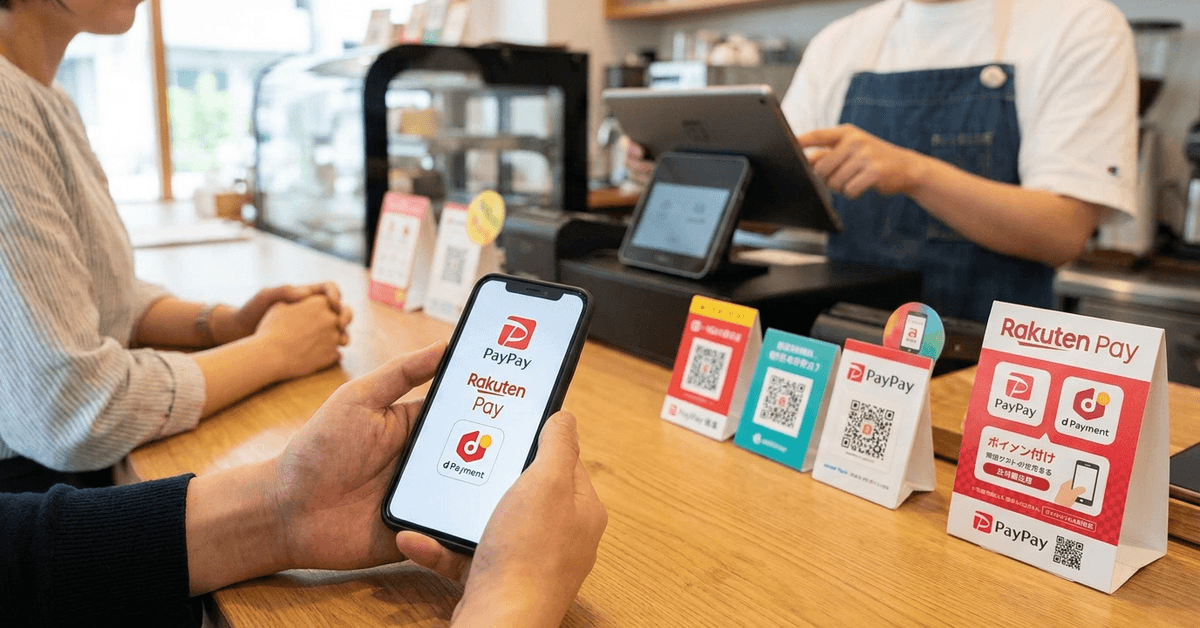
PayPay has 75 million registered users. Rakuten Pay sits at 44 million. And d Payment (d払い) runs on NTT Docomo's telecom network. If you're picking a cashless payment app in Japan, those three names come up every single time.
Most comparisons stop at "PayPay has the most stores." The part they skip: your existing subscriptions, bank accounts, and phone carrier already decide which app pays you back the most.


This guide is for foreign residents and long-term expats who already have a Japanese bank account and phone number, and want to stop leaving points on the table every time they tap their phone at a konbini.
PayPay Is the Default: Should It Be Yours?
PayPay is Japan's largest QR code payment app, with over 4 million merchant locations and roughly 65% of all QR payment volume in the country, per Citcon's 2026 Japan digital payments report.
Those numbers look unbeatable. And for pure store coverage, they are. PayPay stickers appear at ramen shops, chain restaurants, convenience stores, and even small izakayas in rural prefectures.
PayPay Monthly Active Users vs Total Signups
The 75 million registered user figure sounds massive. But the monthly active transactor count is closer to 40 million. A lot of people downloaded PayPay during a promotional blitz and never came back.
I think PayPay's cashback campaigns deserve skepticism because the percentage-back has been steadily shrinking since 2023.
Early adopters got 10% to 20% returns. Current standard cashback sits much lower, and the best rates require stacking conditions that most people won't hit.
Setting Up PayPay as a Foreign Resident
You need a Japanese phone number and a compatible bank account. Most major Japanese banks work. Overseas credit cards will fail. The app runs in Japanese, though some menu labels have partial English translation.
Rakuten Pay Points Add Up Faster Than You'd Expect
Rakuten Pay is the second-largest QR payment app in Japan, holding about 36% of QR payment volume. Its real pull is the Rakuten Super Points system.
Every purchase through Rakuten Pay earns points. Those points spend across Rakuten's full ecosystem: hotel bookings on Rakuten Travel, groceries on Rakuten Seiyu, mobile top-ups on Rakuten Mobile, and credit card payments on Rakuten Card.
Rakuten Points Work Like a Second Currency
A Rakuten Card paired with Rakuten Pay and Rakuten Bank creates a points loop. Spend on the card, fund the app from the bank, earn points on both sides.
The SPU (Super Point Up) program stacks multipliers when you use multiple Rakuten services.
My take on Rakuten Pay: it is the strongest option for anyone who already pays for Rakuten Mobile or shops on Rakuten Ichiba, because points compound across services in a way PayPay simply cannot match.
Where Rakuten Pay Falls Short
Physical store coverage trails PayPay, especially in smaller cities and rural areas. The in-person QR code presence is still catching up regionally. Online coverage, though, is among the widest of all three apps.
d Payment Makes Sense Only if You're on Docomo
d Payment (d払い) is NTT Docomo's QR code payment app, carrying about 28.6% of QR payment volume in Japan. The d Point loyalty program connects to Docomo's phone plans, billing, and partner stores.
The biggest convenience for Docomo subscribers: you can bill purchases directly to your Docomo phone bill. No bank link needed for small charges.
Point multipliers kick in during Docomo-sponsored campaigns, and d Points spend at electronics stores, supermarkets, and Lawson.
d Payment Setup for Non-Docomo Users
You can use d Payment without a Docomo phone plan. But the experience is worse. You lose the phone-bill charging option and the subscriber-only point bonuses. The app is Japanese-only, and foreign card support is very limited.
d Payment Security Is Tied to Your Phone
Docomo links your d Payment account tightly to your device and telecom credentials. If your phone is lost, the account locks faster than PayPay or Rakuten Pay. The tradeoff: setting up a new device takes longer because of telecom verification.
Cashless Payment App Rewards Compared
Each app handles loyalty differently. The points you earn per purchase vary based on which payment method funds the app and what campaigns are running.
| Feature | PayPay | Rakuten Pay | d Payment |
|---|---|---|---|
| QR Payment Market Share | 65% | 36% | 28.6% |
| Merchant Locations | 4 million+ | 5 million (inc. online) | Fewer in rural areas |
| Points System | PayPay Bonus | Rakuten Super Points | d Points |
| Phone Bill Charging | No | No | Yes (Docomo only) |
| English App Support | Partial | Partial | None |
| Foreign Card Support | Very limited | Very limited | Almost none |
The takeaway: PayPay wins on physical store count, Rakuten wins on points flexibility, and d Payment wins on Docomo integration.
Can Foreigners and Tourists Use These Apps?
Japan's cashless adoption rate hit 58% in 2025, with 162.7 trillion yen in cashless spending. But foreign tourists face a frustrating wall.
All three apps require a Japanese phone number. PayPay and Rakuten Pay need a Japanese bank account or compatible card. d Payment is nearly impossible for short-term visitors because of Docomo's telecom requirements.
The Japan Ministry of Internal Affairs and Communications regulates mobile payment access under telecom law, and those rules tighten identity verification for non-residents.
Foreign residents with a valid residence card, Japanese phone number, and bank account can set up all three apps. Tourists on 90-day visa waivers will struggle with any of them.
Which App to Try First as an Expat
If you only install one, PayPay covers the most ground. But I would install both PayPay and Rakuten Pay on day one, because some merchants accept Rakuten Pay but not PayPay, and the reverse is also true. Running two apps costs nothing.
The Part About Data and Privacy Worth Checking
PayPay collects transaction data and device info for anti-fraud monitoring. Japanese privacy law (APPI, amended 2022) governs how all three apps handle personal data.
Rakuten's ecosystem spreads your data across more services: shopping history, travel bookings, mobile usage, and payment records all connect under one Rakuten ID. You can opt out of some marketing features, but doing so may reduce functionality.
d Payment ties into Docomo's telecom data architecture. Your identity verification is telecom-grade, which means more personal information is collected upfront. If minimal data sharing matters to you, none of these three apps are light-touch.
Questions People Ask About PayPay vs Rakuten Pay vs d Payment
These come up constantly in expat forums and search results.
- Q: Can I use PayPay outside Japan?
PayPay is a domestic-only app. There is no international merchant network. If you travel outside Japan, the app won't work for purchases abroad. Some cross-border pilot programs exist through the Alipay+ partnership, but coverage is still thin. - Q: Do Rakuten Pay points expire?
Regular Rakuten Points expire 12 months after your last point-earning activity. Limited-time campaign points expire faster, sometimes within 30 to 45 days. Keep spending or earning to avoid losing your balance. - Q: Is d Payment worth it if I switch away from Docomo?
The app still works, but you lose phone-bill charging and subscriber point bonuses. At that point, PayPay or Rakuten Pay will probably return more per purchase, so switching your payment app along with your carrier makes sense. - Q: Which cashless app has the best cashback in 2026?
It depends on stacking conditions. PayPay's base cashback rate is low. Rakuten Pay's returns spike when paired with Rakuten Card and SPU multipliers. d Payment offers the best returns during Docomo campaigns. No single app wins every month. - Q: Can I link a foreign credit card to any of these apps?
All three apps have very limited foreign card support. Most international Visa and Mastercard cards will be rejected. You need a card issued by a Japanese bank or a Japan-based credit card company.
Conclusion
The three biggest cashless apps in Japan each lock into a different ecosystem. PayPay gives you the widest store coverage and the easiest setup for most residents.
Rakuten Pay rewards compound fastest if you already live inside Rakuten's world of shopping, travel, and mobile. d Payment is the tightest fit for Docomo subscribers who want one less app and one more reason to stay.
Pick the one that matches the services you already pay for, and you won't need to chase promotional cashback.